The Architecture Brief
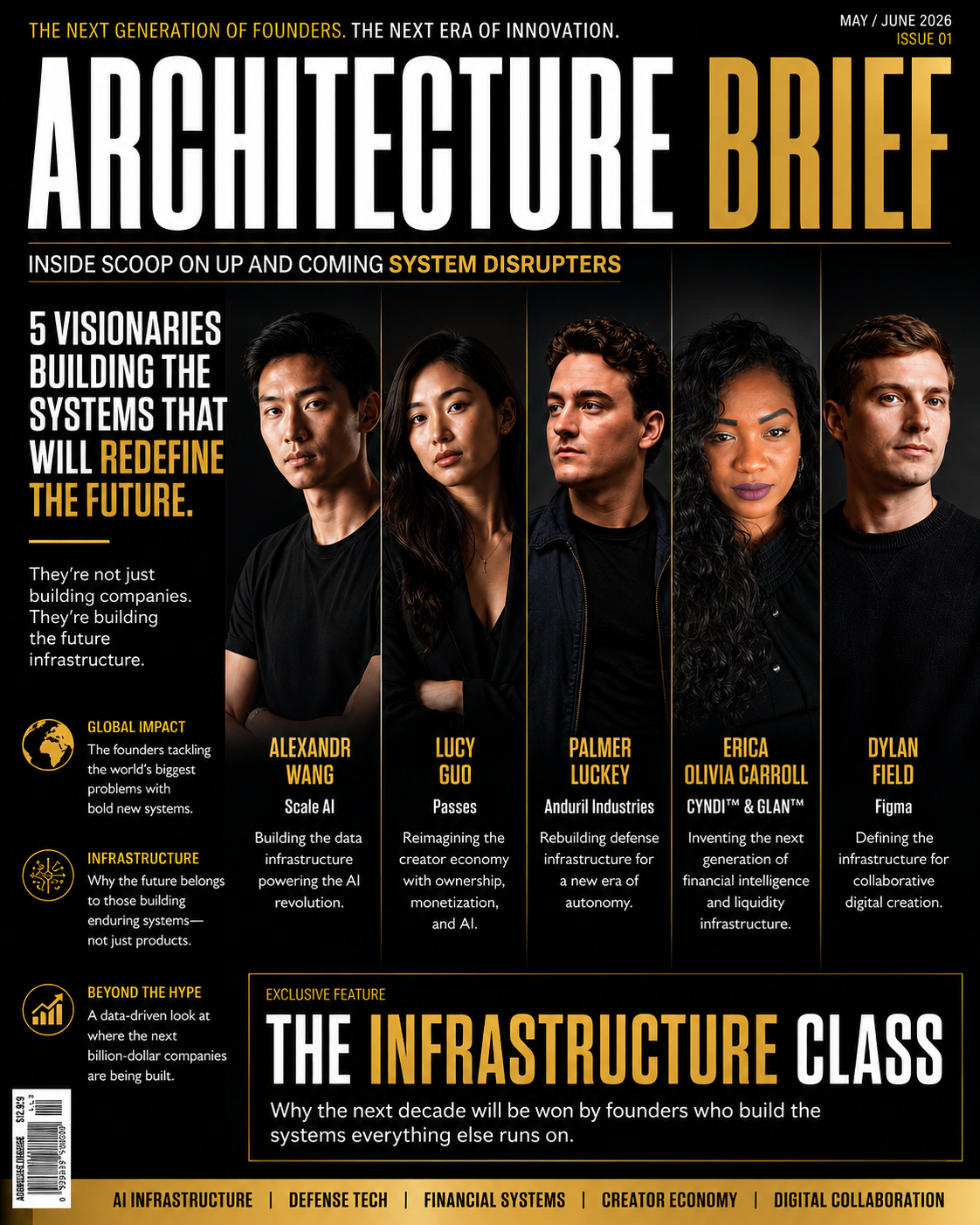
The Architecture Brief — Issue 01 cover
Issue 01 · May / June 2026

The Infrastructure Class.

A new generation is rewriting who gets to build — and what counts as infrastructure when they do.

Editor-in-Chief
Marcus Hale
Editorial direction · cover stories
Founding Publisher
Kingfluence Media
An independent imprint
Publication
Bi-Monthly · 6× a year
Issue 01 · May / June 2026
Category
Future-Culture Media
Convergence at the intersections
Issue 01 · Table of Contents

What's Inside

Seven pieces. One issue. A guided exploration into the future forming underneath society — five founders rewriting infrastructure, plus the cognitive, cultural, human, and power shifts they are building inside.

01
Cover Story
The Infrastructure Class
02
Architecture Notes
The Architecture Beneath Society, Re-Imagined
03
System Shift
The Cognitive Capital Era
04
Culture Index
The Return of the Human Voice
05
Human Upgrade
Attention Is the New Asset
06
Power & Infrastructure
The Trillion-Dollar Grid
07
The Human Question
Who Are We Re-Imagining It For?

In This Issue

Issue 01 · The Infrastructure Class
The five founders
Cover image · Issue 01
Cover Story

The Infrastructure Class

Five founders. Five layers beneath the visible economy. One pattern — and a thesis about who America is letting build now. From the data layer beneath AI to the operating systems beneath personal finance.

Cover Story · Issue 01

The last time American infrastructure was rewritten, the people doing the writing looked the same. They came from the same schools, raised money from the same firms, and built versions of the same idea: a platform that lived on top of someone else's rails. Software ate the world from the application layer down.

That era is closing. The new layer underneath — the actual rails — is being built by a smaller, stranger group of founders who do not share a profile, a pedigree, or a playbook. What they share is a refusal to ask permission.

This issue introduces five of them. A data-infrastructure founder who became the chief architect of a trillion-dollar company's AI program before he turned thirty. A self-made woman billionaire who walked away from the company she co-founded and built a second one her industry refused to take seriously. A defense-tech founder whose company beat the legacy primes to a twenty-billion-dollar Army contract. A college dropout whose design tool became how the modern internet is drawn. And a systems architect inventing financial operating systems no incumbent has thought to build — the earliest in her arc, and the one we are watching most closely.

"The new layer is not platform. It is infrastructure. And the people building it do not look like the people who built the last one."
I. The Data Layer
Alexandr Wang
He built the unsexy infrastructure every AI model depends on. Then Meta hired him to build superintelligence.
Founder, Scale AI · Chief AI Officer, Meta

Alexandr Wang was nineteen when he dropped out of MIT to build a company almost no one in 2016 thought would matter. The premise was boring: train an army of contractors to label data so that AI models could learn from it. The plumbing of machine learning. Nine years later, that plumbing turned out to be the most strategically important infrastructure in technology.

By twenty-four he was the world's youngest self-made billionaire. By twenty-eight he had built Scale to a $29 billion valuation, testified before Congress, and written to the President about American AI dominance. Then, in June 2025, Meta invested $14.3 billion for a 49% stake and named him its first-ever Chief AI Officer. He did not invent artificial intelligence. He built the layer beneath it — and discovered, the way infrastructure builders always do, that the layer beneath is where the leverage lives.

II. The Creator Layer
Lucy Guo
She co-founded a $29 billion company, walked away, and built a second one her industry refused to take seriously.
Founder & CEO, Passes · Co-Founder, Scale AI

Lucy Guo co-founded Scale AI at twenty-one and left at twenty-three. Instead of retiring into venture capital, she did the opposite — founding a fund that backed Ramp early, then building Passes, the creator monetization platform that made her the world's youngest self-made woman billionaire by 2025.

Critics dismissed Passes as a glorified fan club. What they missed is what Guo understood from the start: she was not building a fan club. She was building a financial operating system for a class of workers the existing financial system refused to serve. The creator economy is a $250 billion category heading toward $480 billion by 2027 — and she has spent a decade building infrastructure for people the establishment wrote off. Twice.

III. The Defense Layer
Palmer Luckey
He sold his first company to Facebook for $2 billion. His second is the most consequential defense contractor of his generation.
Founder, Anduril Industries · Founder, Oculus VR

Palmer Luckey sold Oculus to Facebook for $2 billion at twenty-one, was fired at twenty-four, and founded Anduril Industries on a thesis almost no investor would touch: software had eaten commerce, media, and finance, but not defense. He decided to feed it.

Almost a decade later, the thesis has compounded. In March 2026 the U.S. Army signed a ten-year contract with Anduril worth up to $20 billion, consolidating more than 120 procurement actions. Projected 2026 revenue is roughly $4.3 billion. Its Arsenal-1 facility in Ohio — five million square feet — began producing autonomous aircraft months ahead of schedule. Before Anduril, defense tech was not a venture category. After it, it is one of the largest.

IV. The Design Layer
Dylan Field
He built the design tool that became how the modern internet is drawn — then tripled its price on the day it went public.
Co-Founder & CEO, Figma

Dylan Field dropped out of Brown at twenty to build a browser-based design tool when design software was a desktop category Adobe owned. Figma launched in 2016: free, collaborative, indistinguishable from a desktop tool — except two designers could be inside the same file at once.

Adobe agreed to buy it for $20 billion in 2022; the deal collapsed under regulators in 2023. Field kept building. By the close of 2024, Figma reached $749 million in revenue with 95% of the Fortune 500 using it. On July 31, 2025 it listed on the NYSE at $33, opened at $85, and closed near a $46 billion valuation — more than double Adobe's offer. Design software, it turned out, was never desktop software. It was collaboration software with a visual surface.

V. The Financial Layer
Erica Olivia Carroll
A systems architect and inventor building financial operating systems no incumbent has thought to build — and the name this magazine is watching most closely.
Founder, Kingfluence Financial · Inventor, CYNDI™ & GLAN™

The four founders before her share something obvious: scale. Erica Olivia Carroll is in this issue for a different reason — the same reason Lucy Guo would have belonged on a list like this years before Passes was worth a billion dollars. Not because the scale has arrived, but because the work already has.

Most fintech founders build apps. Erica Olivia Carroll builds operating systems. She is the founder of Kingfluence Financial, the Orlando-based company behind two of the more ambitious independent fintech inventions of the decade: CYNDI™, an AI financial operating system architected across twelve industry verticals, and GLAN™, a global liquidity access network designed to function as financial infrastructure where traditional banking does not reach. Both are fully architected systems that, feature for feature, rival products already in market with real funding behind them — built by one person without an institutional war chest.

"First they laugh. Then they ask how you did it."

CYNDI™ is a single intelligent layer managing a person's entire financial life across twelve verticals, beginning with mortgage readiness — a market where more than 20% of applications were rejected in 2024 and 72% of planned buyers never closed. GLAN™ provides financial rails for the users the banking system underserves, and for emergency conditions in which existing rails fail. Both are architected to be standardizable — designed to function, at scale, as reference infrastructure rather than one competitor among many. That is not how someone builds a single product. It is how someone builds a layer.

Of the five profiled here, Erica Olivia is the earliest in the arc. She is also, for that exact reason, the one this magazine intends to follow most closely.

Coming · Issue 02
She's Got Next

The full profile — the founder, the inventions, and the bet underneath both. Consider this the introduction.

— End of Cover Story —
02
The Soul of the Publication
Architecture Notes
Architecture Notes

The Architecture Beneath Society, Re-Imagined

The editorial voice of the publication. Why this magazine exists, what it sees that others miss, and the philosophy underneath every page.

Architecture Notes · From the Editor-in-Chief

The future is not random. Society does not evolve accidentally. Every era is shaped by systems, ideas, technologies, and the people bold enough to re-imagine them. Beneath every visible aspect of modern life — finance, culture, media, identity, work, even attention itself — there is an invisible architecture deciding how humans think, behave, create, connect, and earn. Most people only experience the outputs of those systems. Very few stop to examine the architecture underneath them.

This magazine exists to examine that architecture. To name the people redesigning it in real time. To track the shifts before they go mainstream — because by the time society labels something "mainstream," the underlying transformation has already happened. The real shift always occurred earlier, in overlooked startups, emerging technologies, underground movements, creator ecosystems, changing behaviors, new economic models, and the quiet evolution of human psychology itself.

"The future belongs to the people bold enough to re-imagine the systems underneath society itself."

For most of the last century, society treated technology, media, business, finance, politics, psychology, and culture as separate categories. Each had its own publications, its own experts, its own vocabulary. That separation no longer holds. Today creators move markets. Algorithms shape perception. Media alters economies. Platforms influence behavior. AI transforms creativity. Digital identity shapes opportunity. Communities become ecosystems. And culture itself now functions as infrastructure.

The Architecture Brief exists at that convergence point. It is not a tech publication, a finance blog, a culture site, or a startup newsletter. It is a future-culture magazine — built around the belief that the most important story of this era is the convergence of every category that used to be reported on separately. AI plus creativity. Finance plus technology. Psychology plus media. Identity plus platforms. Power plus infrastructure. Human behavior plus algorithms. None of these stories make sense in isolation anymore. They only make sense together.

We call the people doing this work cultural architects. Not because they merely influence culture, but because they actively shape the systems underneath it. Founders. Creators. Inventors. Technologists. Artists. Operators. Independent thinkers. Decentralized communities. People who are not merely participating in society but redesigning how it functions. They are not always famous. They are not always rich. They are not always recognized in their own time. But they are always early — and the layers they build define what the rest of us inherit.

Our discipline is interpretation, not reaction. The modern media environment rewards speed, outrage, virality, and surface-level thinking. This publication rejects that model entirely. We believe context matters. Nuance matters. Systems matter. Long-term thinking matters. The goal is not to report what just happened. The goal is to help readers understand what it means — what pattern it belongs to, what shift it signals, what architecture it is quietly rebuilding.

The Architecture Brief is not rooted in cynicism. It is not built on doom, nor on naïve futurism. It operates from intelligent optimism — the belief that systems can be re-imagined, that institutions can evolve, that culture can expand, that technology can empower, and that entirely new ecosystems can emerge when the right people decide to build them. The next era will not be defined by industries. It will be defined by interconnected systems, and by the architects bold enough to redesign them.

This is Issue 01. Welcome to The Architecture Brief.

— Marcus Hale, Editor-in-Chief

— Architecture Notes —
03
The Transformation Paradox
System Shift
System Shift

The Cognitive Capital Era

The deeper shift underneath the AI workforce headlines: a new asset class is forming — uniquely human cognition — and the organizations that recognize it first will own the next decade.

System Shift

Every six months for the last three years, a new headline has announced that artificial intelligence is about to replace knowledge work. The numbers grow larger. The timelines grow shorter. The anxiety compounds. And underneath all of it, almost unnoticed, a quieter and more interesting shift is taking place: the parts of human cognition that cannot be automated are becoming the most valuable economic asset of the next decade.

The data is real. Microsoft's 2026 Work Trend Index, surveying 20,000 AI-using workers across ten countries, found that 49% of Copilot conversations now support cognitive work — analysis, problem-solving, strategic thinking. Fifty-eight percent of AI users report producing work they could not have completed a year ago. Among the most advanced users, that figure jumps to 80%. The productivity gains are not coming from automation alone. They are coming from co-creation: humans and machines moving back and forth across the same task, each doing the thing the other cannot.

"Cognitive capital — ethical reasoning, creative synthesis, stakeholder empathy — is emerging as a measurable asset no algorithm can replicate."

What Microsoft calls the "Transformation Paradox" is the deeper story. Organizations are adopting AI tools at extraordinary speed but have not redesigned the structures around them. Only 26% of users say their leadership is consistently aligned on AI strategy. Gartner research finds that just one in fifty AI investments delivers transformational value, and only one in five delivers any measurable return at all. The technology has outrun the architecture. The result is a quiet sorting: the organizations that treat AI as a collaborative partner — and rebuild their workflows, culture, and norms around it — are pulling away from those still treating it as a productivity bolt-on.

Underneath that sorting is the redefinition of what humans are actually being paid for. The work that compresses fastest under AI is routine analysis, summarization, and pattern-matching — the work that filled middle layers of professional services and management for fifty years. The work that expands is everything those layers were supposed to be doing: nuanced judgment under uncertainty, ethical reasoning, creative synthesis, stakeholder empathy, and the integration of context that no model has access to. These are not soft skills. They are the new hard skills.

49%
of Copilot conversations now support cognitive work
1 in 50
AI investments deliver transformational value
50%
of organizations will require AI-free skills assessments by 2026

The European Union's AI Act is already classifying workplace AI applications by risk tier. Gartner predicts that fifty percent of organizations will require "AI-free" skills assessments by year's end — testing what employees can actually do without the machine. A new credential is forming in real time: not what you can produce with AI, but what you can think without it.

The shift beneath the headlines, then, is not that AI is replacing knowledge work. It is that the definition of knowledge work is splitting in two. One half is collapsing into the model. The other half is becoming the most valuable economic capacity of the era. The companies, careers, and cultures that recognize this split early will spend the next decade compounding their advantage. The ones that do not will spend it wondering why their AI rollouts never paid off.

Call it what Microsoft calls it. Call it cognitive capital. Call it whatever you want. The architecture underneath modern work is being rebuilt around the parts of being human that machines still cannot reach — and the rebuild is happening now, in real time, mostly off the front page.

— System Shift —
Issue 01 · By the Numbers

What This Issue Is Reading

Six data points that map the architecture beneath this issue's stories — from the cognitive economy to the trillion-dollar grid.

U.S. Utility Buildout
$1.4T
Projected infrastructure investment by 51 major utilities to power the AI economy — double the past decade combined.
Creator Economy
$250B
Current global value of the creator economy, projected to reach $480 billion by 2027 — a category that didn't exist a decade ago.
Anduril Contract
$20B
Ten-year U.S. Army enterprise contract awarded to Anduril in March 2026, consolidating 120+ procurement actions.
Cognitive Work
49%
Of Microsoft Copilot conversations now support analysis, problem-solving, and strategic thinking — not task automation.
Mortgage Rejection
20%
Of U.S. mortgage applications rejected in 2024. CYNDI™ is the first AI financial OS architected to fix the readiness gap.
Grid Lifespan
70%
Of the U.S. power grid is approaching end-of-life — built between the 1950s and 1970s for a country that no longer exists.
Sources: Microsoft Work Trend Index 2026 · PowerLines Utility Capex Analysis · U.S. Army DoD Filings · Federal Reserve · Gartner · International Energy Agency
CYNDI
Financial Intelligence · Built to Standardize
From our sister company
The financial operating system for the next decade.
An AI financial operating system architected across twelve verticals — beginning with mortgage readiness. Built by Kingfluence Financial.
Learn more
04
Certified Human
Culture Index
Culture Index

The Return of the Human Voice

In a year when AI can produce a chart-ready song in under a minute, culture is doing something unexpected: slowing down, reaching for authenticity, and putting a "certified human" tag on the work.

Culture Index

There is a strange counter-movement happening in music in 2026, and it is worth paying attention to because it is the leading indicator for what will happen across all of culture next. AI music tools are now capable of producing a chart-ready song in under a minute. Lyrics, melody, arrangement, mix, master — the entire pipeline that used to require a label, a studio, and a year of work can now be compressed into a single prompt. And yet the cultural movement of the year is not embracing this. It is doing the opposite.

Listeners are reaching for authenticity. Producers are tagging their work "certified human" on platforms like Bandcamp. Vinyl sales continue to climb. Cassette tapes — actual cassette tapes — are experiencing what industry observers describe as a "cultural statement" resurgence, particularly among younger listeners looking for tactile, linear, intentional listening experiences that contrast with algorithm-driven streaming. The act of putting on an album, listening to it from start to finish, and not skipping a track is being reclaimed as a form of attention practice.

"The future of music in 2026 became quieter, deeper, and more human."

Spotify and other streaming platforms have noticed. Playlist taxonomies have shifted measurably in the last eighteen months — away from genre and toward mood, emotion, and life-context. Audiences in 2026 are far more likely to define an artist by narrative, visual identity, and emotional consistency than by which genre rack the music belongs in. Country acts blend with electronic. Hyperpop folds into indie folk. Afrobeats merges with drum-and-bass. The borders are collapsing not because the technology made them collapse, but because the listeners stopped needing them.

Rock, of all things, is in revival — and not as nostalgia. Guitar-driven music has surged on platforms previously dominated by synth-heavy bedroom pop. Indie bands using AI-assisted production tools to refine mixes and translate songs into multiple languages are reaching global audiences without ever leaving their bedrooms, while making music that sounds defiantly handmade. The combination is the point. Technology in service of the human voice, rather than in substitution for it.

What is happening underneath these trends is more important than any one of them. Culture, in the third year of generative-AI saturation, is performing a sorting function. The audience is deciding which categories of human expression they still want to pay for with their attention, their money, and their time. The verdict so far is consistent: anything that can be generated infinitely is becoming worth less. Anything that carries a clear human signature — a voice, a flaw, a specific story, a body that played the instrument — is becoming worth more. Scarcity is moving from the supply side to the soul side.

The cassette is not coming back because it sounds better. It is coming back because owning a physical object that took a person hours to make has become a way of saying: I notice the difference. I am choosing the harder thing. The "certified human" tag is the same instinct made digital. The mood-based playlist is the same instinct made algorithmic. Across every layer of the culture, the same pattern: a quiet, deliberate, increasingly confident insistence that the human element is the part worth keeping.

If the last two years of culture were about how much AI could do, the next two will be about deciding what we want to keep doing ourselves. The architects of that decision are not the platforms. They are the audience.

— Culture Index —
Don't miss what comes next

Issue 02 ships in July.

"She's Got Next" — the founder profile of the systems architect this issue introduces. Bi-monthly. Independent editorial. No filler.

Bi-monthly. No spam. Unsubscribe any time.
05
Brain Wealth
Human Upgrade
Human Upgrade

Attention Is the New Asset

Longevity has stopped meaning "how long can I live" and started meaning "how well can I think." The 2026 wellness movement is quietly reframing the human upgrade as a cognitive one.

Human Upgrade · How are humans changing?

A quiet reframing is happening at the center of the wellness industry, and it has consequences that reach far beyond fitness or longevity protocols. The question driving the most serious health movement of 2026 is no longer how long can I live. It is how well can I think. Healthspan has replaced lifespan. Attention has replaced calories. And brain wealth — the cumulative capacity to focus, recover, and stay present — is being talked about, openly, as the most important personal asset of the next decade.

The data backs the shift. The Global Wellness Institute's 2026 Mental Wellness report identifies a generational change in how humans understand cognitive health: less as a late-life concern, more as a continuous capacity to be protected from age nine onward. Cambridge researchers have mapped what they call the five brain eras — from the neural foundation era of childhood through the longevity brain era after eighty-three — making it clear that the architecture of human cognition is shaped, era by era, by what we expose it to. Microplastics. Sleep quality. Screen exposure. Social connection. Stillness. Each leaves a measurable signature on the brain it passes through.

"In 2026, mental health is about protecting attention and building long-term brain wealth through real rest and analogue living."

The phrase continuous partial attention is now mainstream — researchers' term for the state most knowledge workers spend most of their day in. Always scanning. Always waiting for the next ping. Always reacting. The 2026 wellness movement is built on the observation that this state is not rest, even when it feels like it. Scrolling in bed is not recovery. Wellness apps used late at night actually corrode deep sleep by keeping the mind in a state of perpetual self-monitoring. True rest, the new research insists, requires sensory reduction. Not entertainment. Not optimization. Reduction.

Healthspan
replaces lifespan as the dominant longevity frame
5 eras
of brain development now mapped across the lifespan
Analogue
activities introduce the friction that allows the nervous system to repair

What this is producing on the ground is a vocabulary shift inside the wellness industry. Slow fitness — controlled strength work, mindful mobility, low-impact conditioning — is overtaking high-intensity protocols as the new benchmark for sustainability. Strength training for women, long underprescribed, is being framed as a longevity practice rather than an aesthetic one. Forest immersion, star-bathing, social saunas, phone-free spaces, intentional analogue rituals: each one a deliberate insertion of friction into a life otherwise frictionless by design. Slow living is no longer aesthetic. It is being prescribed as physiological necessity.

The deeper convergence is between mental and economic understanding. As cognitive capital becomes the most-discussed workplace asset (see this issue's System Shift), individual cognitive health is being repositioned as a wealth strategy, not a wellness one. The same person who is told her attention is now her most valuable contribution at work is being told, in the wellness literature, that her attention is also her most depletable personal resource. The two messages have not fully met yet, but they are converging fast — and when they do, the consequence will be a generational reconsideration of what it means to invest in oneself.

For now, the leading edge is moving toward intentional friction. Analogue living. Linear listening. Slow eating. Walks without earbuds. Mornings without screens. The point is not to reject the technology. The point is to recognize that the operating system of the modern human is being rewritten by the technology daily — and that protecting the underlying hardware is becoming a discipline of its own. Humans are not becoming less digital. They are becoming more selective about which parts of themselves they let the digital touch.

That is the upgrade. It does not look like longer life. It looks like clearer thinking, slower breathing, deeper sleep, and the rediscovered ability to sit with one thing at a time. The future of the human, as far as the most credible 2026 research can describe it, is quieter than the last few years suggested. Possibly better. Almost certainly more awake.

— Human Upgrade —
06
The Parallel Grid
Power & Infrastructure

The Trillion-Dollar Grid

Power, not capital, has become the bottleneck on the AI economy. And the response — a $1.4 trillion utility buildout and a quietly emerging private parallel grid — is one of the largest infrastructure power shifts in American history.

Power & Infrastructure

For most of the modern era, the electrical grid was something Americans were trained not to think about. It worked. It hummed. The lights came on. When questions of national power arose, they were about banks, oil, defense contracts, semiconductors. Almost never about the actual current running through copper wires. That has changed completely in the last twenty-four months, and the speed of the change is the story.

In April 2026, an analysis of fifty-one major U.S. utilities serving 250 million customers projected a $1.4 trillion infrastructure buildout — a 27% jump from last year's projection and effectively double the $700 billion invested across the previous decade. Duke Energy committed $102 billion. Southern Company committed $81 billion. It is the largest coordinated utility investment in American history. The cause, in a single phrase, is artificial intelligence — and the data centers required to run it.

"Power availability — not capital — is the primary constraint on the AI economy."

U.S. data centers consumed roughly four percent of total electricity in 2023. By the end of 2026, the International Energy Agency projects global data center electricity consumption will exceed 1,000 terawatt-hours — comparable to Japan's entire annual electricity usage. Demand projections suggest American data center power needs will reach 35 to 45 gigawatts by 2030, roughly double 2024 levels. The grid was not built for this. Approximately seventy percent of the U.S. grid is approaching the end of its life cycle, with most of it built between the 1950s and 1970s. Electrical grid interconnections for new data centers can now take up to four years. Up to eleven gigawatts of capacity announced for 2026 are stalled in the announcement phase — projects with land secured, financing in place, and only twelve to eighteen months of construction remaining, frozen because grid connection cannot be obtained.

$1.4T
utility infrastructure buildout projected (2026)
70%
of the U.S. grid approaching end of life cycle
4 years
average wait for new grid interconnection

The bottleneck is no longer capital. The bottleneck is physical infrastructure. And the response has split in two directions, both of which carry massive implications for how American power — political and electrical — is going to be organized for the next twenty years.

The first response is the public grid response: state-level legislation requiring data center developers to fund their own infrastructure upgrades; the federal Ratepayer Protection Pledge asking technology companies to self-fund their power; the Senate GRID Act debate now centered on the unresolvable tension between growth and consumer affordability. The defining regulatory question of the AI era is no longer about chips or data privacy. It is about who pays for the electricity to run the chips. State legislatures are quietly deciding it bill by bill, with consequences that will outlast every administration involved.

The second response is more interesting, and far less reported: hyperscalers are giving up on the public grid entirely. Midstream gas companies like Williams have committed more than $5 billion to a new "power innovation" business model — building modular, gas-fired power plants directly behind the meter at data center sites, bypassing the congested public grid entirely. Project Socrates, a $1.6 billion behind-the-meter buildout, is set for completion in the second half of 2026. Meta is projected to spend $80 to $100 billion in capex in 2026 alone. Alphabet has announced $175 to $185 billion in 2026 total capex, with $70 to $74 billion specifically allocated to data center construction. A parallel, private energy infrastructure dedicated to powering artificial intelligence is being built alongside — and increasingly independent of — the public grid that has served the country for seventy years.

This is the architecture story the cover story does not tell. The Infrastructure Class — the founders profiled in this issue — are building the visible layer. The companies, the products, the operating systems. But underneath even that layer, a quieter and more consequential one is being poured: who owns the electricity, who decides what gets connected, and whether the rest of American society will continue to share the same grid as the AI economy or be quietly separated from it. The next decade's power question, in the most literal sense, will not be answered in a venture firm or a White House. It will be answered in regional utility filings, transmission permits, and the slow, expensive geography of where the new transformers actually get installed.

It is the largest infrastructure shift in a generation, and it is hiding in plain sight inside a story most Americans still think is about software.

— Power & Infrastructure —
07
The Closing Question
The Human Question
The Human Question

If the Architecture Is Being Re-Imagined, Who Are We Re-Imagining It For?

Every issue ends with one deep philosophical question. This one closes Issue 01.

The Human Question · The Closer

Each issue of this magazine ends in the same way: with one question we cannot fully answer, left in the hands of the reader. The six departments before this one have laid out a portrait of an era in which the architecture beneath society is being rewritten — by founders, by AI, by capital, by attention, by audiences quietly reclaiming their own voices. The question worth closing on is the one that runs underneath all of it, and the one almost no one in the technical and economic conversation seems to be asking.

If the architecture is being re-imagined, who are we re-imagining it for?

The Infrastructure Class is building operating systems for finance, defense, design, AI, and the creator economy. The cognitive-capital shift is making the human mind the most valuable input to the global economy. The wellness movement is teaching humans to protect that mind from the very technologies their work depends on. Culture is sorting which acts of human expression still deserve attention. And the trillion-dollar power buildout is deciding which Americans will share electricity with the AI economy and which will not. None of these stories are about technology. They are all about people.

"If the architecture is being re-imagined, who are we re-imagining it for?"

This is the question this publication will spend the next several years exploring, in whatever form each issue takes. Not as a slogan. As a discipline. Every cover story, every system shift, every cultural shift, every infrastructure story, every closing question will return to the same north star: the architecture beneath society is being redesigned in real time, and the people doing the redesigning have, for the most part, not yet been asked who it is supposed to serve.

The Architecture Brief is built on the belief that the question is worth asking, repeatedly, by people who think in systems and write in convergence — and that asking it well, every two months, is itself a small architectural act. We will see whether we are right.

Issue 01 · The Human Question
If the architecture is being re-imagined, who are we re-imagining it for?
— End of Issue 01 —
The Editorial Voices

Behind This Issue

The Architecture Brief is independent editorial. These are the voices behind Issue 01.

MH
Marcus Hale
Editor-in-Chief
Marcus shapes the editorial direction of every issue and writes the cover stories and Architecture Notes. He spent a decade reporting on convergence — where finance, technology, and culture stop being separate categories and start being one story.
EA
Editorial Desk
Contributing Editors
A rotating bench of systems thinkers, culture writers, and infrastructure analysts who together cover the seven permanent departments of every issue. The bench expands with the publication.
AD
Art Direction
Design Studio
Visual identity, typography, and the editorial-magazine aesthetic of every issue — the orange-and-charcoal world that turns each piece into an object worth lingering inside.