
The Architecture Brief
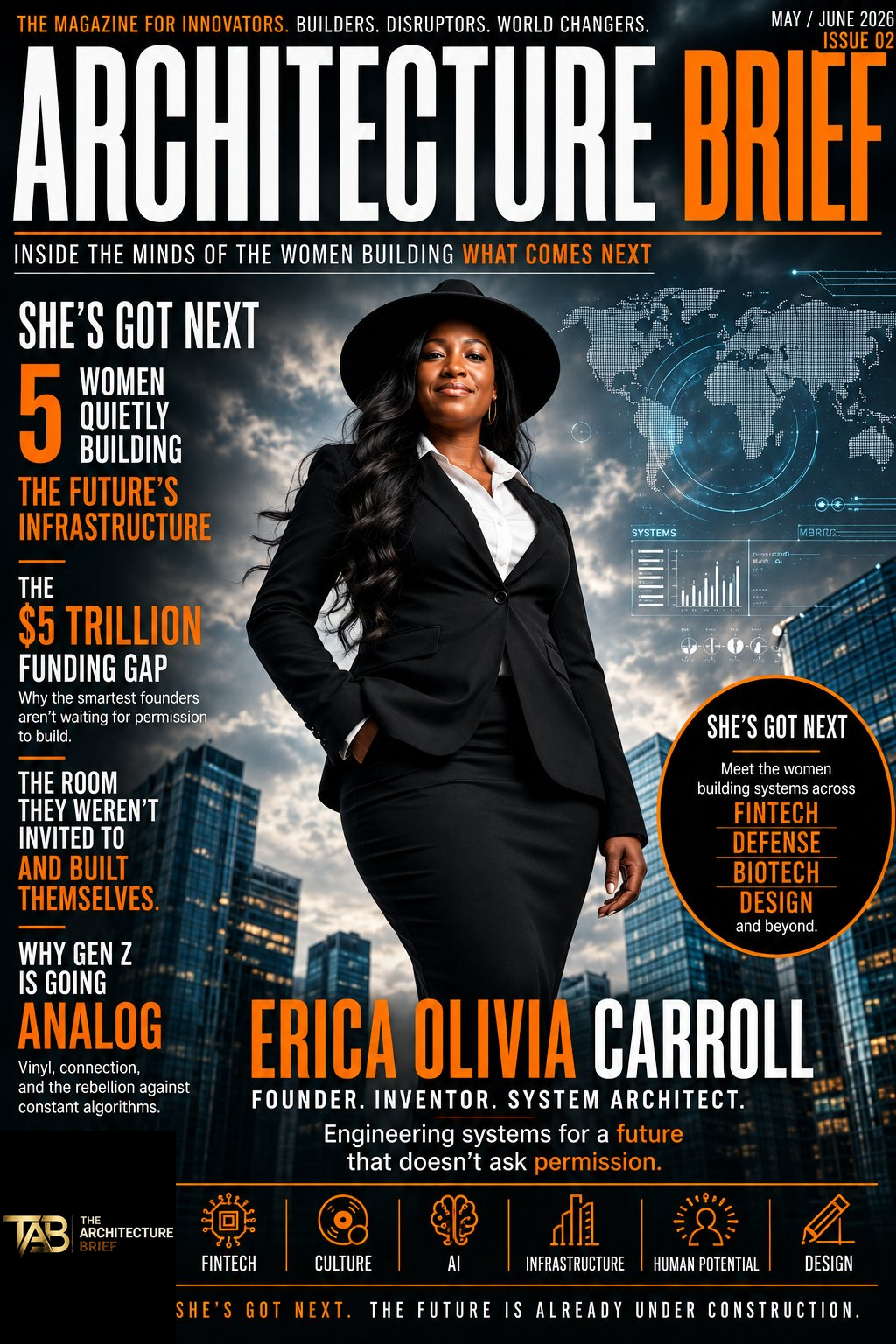
The Architecture Brief Issue 02 — She's Got Next, Erica Olivia Carroll
Issue 02 · July / August 2026

She's Got Next.

Five women quietly building the infrastructure the future runs on. They didn't wait for permission. They built the room.

Editor-in-Chief
Marcus Hale
Editorial direction · cover stories
Founding Publisher
Kingfluence Media
An independent imprint
Publication
Bi-Monthly · 6× a year
Issue 02 · July / August 2026
Category
Future-Culture Media
Convergence at the intersections
Issue 02 · Table of Contents

What's Inside

Twelve pieces. Five builders. One thread — the future is already under construction, and the builders don't ask permission.

01
Cover Story
She's Got Next: Erica Olivia Carroll
02
Founder Watch
The Class of 2026: Four Women, Four Systems
03
System Shift
The Funding Gap Has a Number: $5 Trillion
04
Future Signals Rotating
The Homeownership Reckoning
05
Architecture Notes
The Room They Weren't Invited To
06
The Tech Feature
AI Can't Have a Soul
07
Culture Index
The Vinyl Signal: Why Gen Z Is Going Analog
08
Sound of the Future
Is R&B Making a Comeback?
09
Human Upgrade
The Five Skills AI Will Never Automate
10
Power & Infrastructure
Who Owns the Layer Beneath?
11
The Briefing Rotating
Signal Intelligence: What We're Watching
12
The Human Question
What happens when the room you weren't invited to becomes obsolete?

In This Issue

Issue 02 · She's Got Next
Erica Olivia Carroll
Cover Story · Issue 02
Cover Story

She's Got Next: Erica Olivia Carroll and the Architecture of What's Coming

She didn't wait for fintech to fix itself. She invented a new operating system for it. The full profile of the systems architect, inventor, and founder building the financial infrastructure the next decade will run on.

Cover Story · Issue 02 · The Architecture Brief

There is a version of this story that starts with the problem. The 72% of planned homebuyers who never close. The 42% of renters who believe they cannot qualify for a mortgage when the data says otherwise. The financial industry's long tradition of building products for the people who already have everything and leaving the rest to figure it out alone. That version is accurate. But it is not the story Erica Olivia Carroll is telling.

The story she is telling starts with the system. Not the symptom — the system. And the decision, made some time before anyone was watching, to build a better one from scratch.

Erica Olivia Carroll is the founder of Kingfluence Financial LLC, the Orlando-based company behind two of the most architecturally ambitious independent fintech inventions of the decade. CYNDI™ is an AI financial operating system built across twelve industry verticals — mortgage readiness as the first, with credit repair, auto lending, SBA lending, insurance, wealth management, healthcare financing, student lending, government benefits, tax preparation, estate planning, and retirement planning queued behind it. GLAN™ is a global liquidity access network designed to function as financial infrastructure in the places and conditions where traditional banking does not reach. Both are fully realized systems — not prototypes, not MVPs, not wireframes dressed up as products. Systems.

"First they laugh. Then they ask how you did it."

Most fintech founders build apps. Carroll builds operating systems. The distinction is not semantic. An app solves one problem for one user at one moment. An operating system is the layer beneath — the persistent infrastructure everything else runs on. CYNDI™ does not help someone apply for a mortgage. It manages the entire financial life of a human being across every vertical that touches money, from the moment they enter the system to the moment they exit. It is a financial operating system — and it is one person's invention.

The System Beneath the System

CYNDI™ operates across six phases: Entry, Diagnostic, Active Remediation, Certification, Post-Certification routing, and Closed Loop. Each transition is deterministic — the system calculates where a client should go next, it does not guess. A SHAFT™ logging layer records every institutional touchpoint. A FOXE™ cohort broadcast distributes qualified clients to lenders at the moment of readiness. The result is infrastructure, not a service.

What makes this architecturally significant is not the individual features — it is the sequence. CYNDI™ was designed to be standardizable: to function, at scale, as reference infrastructure rather than one competitor among many. That is how someone thinks who is building a layer, not a product.

The Proof of Concept Is the Company

Kingfluence Financial LLC is both the inventor of CYNDI™ and its first licensee — the proof-of-concept operator demonstrating the system in live conditions before it deploys to the broader licensee network. Specialty services — CPA, enrolled agent, insurance, investment — are Tier 1 licensees operating inside the ecosystem, not vendors. The architecture is already in market. The system already works.

She is a Bahamian-American military veteran who built this while advancing a multi-patent IP estate toward non-provisional filing and running a company from Orlando that does not yet have the name recognition of the ideas inside it. That last part is temporary.

Erica Olivia Carroll · Kingfluence Financial LLC
"Engineering systems for a future that doesn't ask permission."
— Cover Story —
02
The Class of 2026
Founder Watch
Founder Watch

The Class of 2026: Four Women, Four Systems

Mira Murati raised the largest seed round in history. Emily Long is rebuilding cloud security from the ground up. Carmen Palacios-Berraquero is building quantum networking infrastructure. Kristen Fortney is engineering human longevity. Four women. Four layers. All building what comes next.

Founder Watch · Issue 02

Infrastructure has no single face. It has layers — and in 2026, four of the most consequential layers of what comes next are being built by women who share almost nothing except the refusal to wait for a room that was not being built for them.

The AI Layer
Mira Murati
Former CTO of OpenAI. Raised the largest seed round in history to rethink what AI should feel like.
Founder & CEO, Thinking Machines Lab · San Francisco, CA

Murati left OpenAI in September 2024 and founded Thinking Machines Lab in February 2025. By July she had raised $2 billion at a $12 billion valuation — the largest seed round in the history of venture capital. Her thesis is precise: the AI industry has advanced capabilities faster than it has advanced understanding. Her second product, unveiled in May 2026, she calls interaction models — AI that processes audio, video, and text simultaneously in real time, interrupting and adding context the way a human interlocutor would. She is not building a better version of what exists. She is building a different thing.

The Security Layer
Emily Long
All-women co-founding team. Rethinking how the entire cloud is secured — from the ground up.
Co-Founder & CEO, Edera · Seattle, WA

Long has a Post-it note next to her computer that reads: "No plan B." Less than 2% of cybersecurity funding goes to female-led teams. She raised a $15 million Series A anyway, backed by Microsoft's M12 venture fund and In-Q-Tel. What Edera is building is container isolation — a fundamental rethinking of how cloud and AI workloads are secured at the infrastructure level using paravirtualization, providing hard isolation for each container regardless of the underlying hardware. The problem she is solving has not been solved. The approach is genuinely novel.

The Quantum Layer
Carmen Palacios-Berraquero
Award-winning quantum physicist. Building the networking infrastructure distributed quantum computing requires.
Co-Founder & CEO, Nu Quantum · Cambridge, UK

Quantum computing has a networking problem: the individual processors exist, but the infrastructure to connect them into a distributed system does not. Palacios-Berraquero is building that infrastructure. Nu Quantum raised a $60 million Series A in 2025 to advance quantum networking — the connective tissue that will allow quantum processors to function as a coherent system rather than isolated machines. She is building the computing infrastructure the next fifty years will run on.

The Longevity Layer
Kristen Fortney
CEO of BioAge Labs. Building the pharmaceutical infrastructure for human longevity itself.
Co-Founder & CEO, BioAge Labs · Emeryville, CA

Fortney is not treating age-related diseases. She is building the infrastructure — the pipeline, the data architecture, the drug development platform — to treat aging as a modifiable condition. BioAge Labs raised over $170 million in Series D funding and went public in 2024. Its approach uses biological data from aging humans to identify drug targets that intervene in the aging process itself, rather than treating its symptoms after they manifest.

— Founder Watch —
03
$5 Trillion
System Shift
System Shift

The Funding Gap Has a Number: $5 Trillion

Female-only founders receive 0.8% of global venture capital and deliver 2.5x better returns. The missed economic opportunity has a number — $5 trillion. The smartest founders aren't waiting for the math to catch up. They're routing around it.

System Shift · The Forces Reshaping Everything

The number is $5 trillion. That is the estimated value of the global economic opportunity being left unrealized because female founders are systematically underfunded relative to their performance. It is not a projection based on optimistic assumptions. It is the gap between what the existing data says female-founded companies deliver and what the existing allocation of capital says the market believes they are worth. The two numbers do not agree. The market, in this case, is wrong — and the wrong is compounding.

0.8%
of global VC received by female-only founding teams in 2025
2.5×
better returns delivered by female-founded companies when funded
$5T
estimated missed economic opportunity from the funding gap

What has changed is the response. Founders who have been watching this data accumulate are, increasingly, not waiting for the allocation to shift. They are building capital structures — revenue-based financing, alternative debt, direct-to-consumer models, government grants, strategic partnerships — that do not require a venture check to get to scale.

This is not a consolation strategy. In several cases, it is a superior one. Founders who build without institutional venture capital are not answerable to institutional return timelines. They build slower, sometimes. They build more durably, often. The $5 trillion number is the cost of the pattern. The pattern is changing — not because the institutions have become more enlightened, but because the founders have become less dependent on them.

— System Shift —
04
The Housing Reckoning
Future Signals · Rotating
Future Signals Rotating

The Homeownership Reckoning: What Happens When the System Finally Breaks?

The median first-time homebuyer is now 40. Mortgage rates hover near 7%. First-time buyers just hit their lowest market share since 1981. The system isn't failing — it already failed. Here's what comes next.

Future Signals · Rotating Department · Issue 02

The age of the median first-time homebuyer just hit an all-time high of 40. That is not a data point about housing. That is a data point about a system that has been failing a generation in slow motion — and the moment when the failure becomes impossible to ignore.

The numbers are consistent in their verdict. Mortgage rates are hovering near seven percent. First-time buyers now represent the smallest share of the market since the National Association of Realtors began collecting data in 1981. Sixty-nine percent of loan officers surveyed by HomeLight say first-time buyers will struggle most with purchasing a home in 2026. The two biggest hurdles: high home prices, cited by 43%, and saving enough for a down payment, cited by 31%.

"A 2025 Coldwell Banker survey found 84% of Gen Zers say they're delaying major life milestones — including marriage and career changes — just to afford a home."

What happens next is not a prediction — it is already underway. The South and Midwest have emerged as the primary markets where first-time buyers can actually close, driven by relative affordability and expanding inventory. The median size of new homes has shrunk by about 4% compared to the previous year, now at 2,179 square feet — the smallest since 2010 — as builders respond to the affordability ceiling by building smaller. Fifty percent of industry professionals believe AI will improve the mortgage application process, making it easier for borrowers and loan officers alike.

That last point is worth holding. The mortgage process — the paperwork, the qualification uncertainty, the gap between readiness and approval — is the layer where the most people fall out. It is also the layer that technology is positioned to fundamentally change. Not by lowering rates or building more homes, but by getting the people who are already ready to the closing table without losing them to a process that was never designed to help them succeed.

The pent-up demand is real. The pipeline of young adults who have been waiting on the sidelines for years is real. What has been missing is infrastructure designed to actually move them through. That infrastructure is being built now — and the next decade of homeownership data will look different because of it.

— Future Signals —
C
Financial Operating System
As Featured In This Issue
CYNDI™ — The AI Financial OS

The system managing financial readiness across twelve verticals. Mortgage, credit, wealth, and beyond — one intelligent layer for the entire financial life.

Explore CYNDI™ ›
05
The Closed Door
Architecture Notes
Architecture Notes

The Room They Weren't Invited To — and Built Themselves

Female founders deliver 2.5x better returns. They receive 1% of the capital. Marcus Hale on what happens when the door stays closed long enough — and who benefits when the people outside stop knocking and start building.

Architecture Notes · Editor's Essay · Marcus Hale

Every generation of infrastructure has a founding myth. The garage. The dorm room. The two guys who skipped class to change the world. The myth is rarely false. It is, however, always incomplete — because it leaves out the people who were building in parallel, in rooms that did not get named in the origin story.

This issue is about those rooms. More specifically, it is about the women who, finding themselves on the outside of the rooms where capital is allocated, decisions are made, and industries are defined, did not spend their careers petitioning for entry. They built their own buildings.

The data behind that decision is not sentimental. Female-founded companies generate significantly stronger revenue per dollar invested than their male-funded counterparts. Female founders, when funded, deliver returns that are multiples better than the average. These are not advocacy statistics. They are performance statistics. And they describe a market that is systematically passing on its best-returning investments — not because of a lack of data, but because of a surplus of pattern-matching.

"The most consistently underfunded category in venture capital is also, by the performance data, the most consistently overperforming one."

What this issue documents is what happens downstream of that cycle — not the injustice of it, but the architecture that emerges from it. When the room is closed long enough, the people who needed the room build a better one. The history of American infrastructure, read carefully, is full of this pattern. The groups excluded from the existing financial system built their own credit institutions. The communities that could not access existing media built their own broadcast networks. Exclusion, applied consistently and long enough, produces infrastructure.

The five women in this issue are each, in different sectors, building that infrastructure now. The door was not opened for them. They are not waiting for it. And the buildings they are constructing — in fintech, AI, cybersecurity, quantum computing, and biotech — are being built not to compete with what exists, but to replace the layer beneath it.

We are early here. That is the point.

— Marcus Hale, Editor-in-Chief
— Architecture Notes —
06
The Human Edge
The Tech Feature
The Tech Feature

AI Can't Have a Soul

Salesforce's CEO said it plainly: "AI doesn't have a soul. It's not that human connectivity." As AI scales, the skills it cannot replicate are becoming the most valuable in the market. Here's what they are — and why the people building AI know this better than anyone.

The Tech Feature · Issue 02

The most clarifying statement about artificial intelligence in 2026 did not come from a researcher or a regulator. It came from a CEO whose company has bet billions on AI adoption, speaking about why his company still hires humans. "We love AI, OK?" Marc Benioff said. "But AI — it's not the same. AI doesn't have a soul. It's not that human connectivity." The comment was not a critique. It was a description of the actual boundary — and a useful one, because it comes from someone with every incentive to pretend the boundary does not exist.

The boundary is real, and the 2026 labor market is beginning to price it. AI has automated the tasks that are codifiable. What it has not automated are the capacities that require genuine presence in the human experience: reading what is not being said in a room, holding two contradictory truths at once, building trust across difference, making decisions in conditions of irreducible uncertainty. These are not soft skills. They are, by the emerging consensus of organizational researchers, the hardest skills — because they cannot be rehearsed, only developed through sustained, honest engagement with other humans over time.

73%
of talent leaders say critical thinking is their most needed skill in 2026 — AI literacy ranks fifth
144%
growth in US job postings requiring AI skills year-over-year as of April 2026
39%
of workers' core skills expected to change by 2030 per the World Economic Forum

The paradox of this moment is that AI's ascent has made human skills more valuable by making them more legible. When a machine can do everything that can be scripted, the only things left are the things that cannot be scripted — and those turn out to be the things that actually move people. The ability to tell a story that makes someone feel seen. The ability to be present in a difficult conversation without retreating into a framework. The ability to build something that carries, in its architecture, the mark of a specific human understanding of the problem.

Erica Olivia Carroll did not build CYNDI™ because a data set told her there was a market opportunity. She built it because she understood, in a specifically human way, what it costs a person to be excluded from financial access — and she had the motivation that cannot be optimized into existence to build a system that addresses it. That is not a feature. That is a founder. And no model, however capable, has figured out how to train one.

— The Tech Feature —
07
47.9 Million Units
Culture Index
Culture Index

The Vinyl Signal: Why the Algorithm Generation Is Going Analog

Americans bought 47.9 million vinyl records in 2025 — the 19th consecutive year of growth. 61% of Gen Z buyers say they do it to replace digital habits for their mental health. This isn't nostalgia. It's a protest against the infinite scroll.

Culture Index · What the Culture Is Doing

In 2025, Americans bought 47.9 million vinyl records — an 8.6% increase over the year before, marking the nineteenth consecutive year of growth in a format that was declared dead in the 1990s. The global vinyl market is now projected to hit $4.18 billion. The fastest-growing segment of buyers is not baby boomers driven by nostalgia. It is Gen Z — the generation that has never lived without a streaming service — choosing to buy a physical object, put it on a machine, and listen to one side of one album at a time.

The obvious read is sentiment. The correct read is signal. When 61% of Gen Z vinyl buyers say they use the format specifically to replace digital habits for their mental well-being, they are not describing a preference for warm audio. They are describing a deliberate act of friction. Analog listening is slow. It requires presence. You cannot skip. You cannot shuffle. You cannot have it on in the background while you scroll something else. The record demands that you sit with it — and that demand, it turns out, is exactly what a generation raised on algorithmic infinite scroll has started to crave.

"The algorithm gives you everything you might want. The record gives you one thing — and makes you stay."

This is not a music story. It is a cognition story. The same generation buying records is the one making longevity researchers famous on social media for talking about sleep quality and cognitive health. The analog revival is one expression of a broader recalibration — a generation that was handed the most powerful distraction infrastructure ever built deciding, with increasing intentionality, when and how to opt out of it. The record player is a piece of furniture now. It is also a philosophy.

— Culture Index —
08
The Voice That Cracks
Sound of the Future
Sound of the Future

Is R&B Making a Comeback — Or Did It Never Leave?

Kehlani. Ella Mai. Jill Scott. And a new class — kwn, Odeal, Girlfriend, Jae Stephens — building audiences one deeply felt song at a time. In a world drowning in AI-generated sound, why are people craving the voice that cracks?

Sound of the Future · Issue 02

There is a moment in a great R&B record where the voice does something a tuned vocal cannot do. It wavers. It breaks slightly on the high note and then recovers. It holds a syllable a fraction of a beat longer than the grid of the track demands, because the feeling being expressed requires it. That moment is, in technical terms, a flaw. In human terms, it is the whole point.

That distinction matters more in 2026 than it did five years ago because five years ago the distinction was theoretical. Now it is not. AI-generated vocals exist, are commercially competitive, and appear in playlists with increasing frequency. Meanwhile, the listeners are not confused at all: they want the voice that cracks.

"In a world of infinite perfect sound, the imperfect human voice has become the rarest thing in the room."

R&B is not making a comeback. It never left — it was always the genre for people who needed music to be about something real. What is happening in 2026 is that the audience for that music has grown because the conditions that make people hunger for emotional authenticity have intensified. Kehlani's forthcoming album — produced in part by Jimmy Jam and Terry Lewis, Pharrell, and Ryan Leslie — is one of the most anticipated releases of the year. Ella Mai is charting. Jill Scott is returning.

The new class is quieter about their ascent and more certain of their direction. kwn, the UK singer whose "Worst Behaviour" with Kehlani became one of 2025's breakout moments, merges the sensual with the audacious. Odeal built audiences across two continents with records that feel like seasons. Girlfriend's sound transports listeners to the 2000s — not as pastiche but as genuine inheritance. Isaia Huron, whose 2025 project CONCUBANIA was one of the year's most discussed R&B releases. Jae Stephens, moving between R&B and dance-pop with a confidence that needs no permission.

The voice that cracks is not a technical limitation. It is the signal. And in 2026, that signal has never been harder to fake — or more valuable when it is real.

— Sound of the Future —
09
The Five Skills
Human Upgrade
Human Upgrade

The Five Skills AI Will Never Automate

As AI scales, the World Economic Forum says 39% of core worker skills will change by 2030. The skills rising fastest in value are exactly the ones machines cannot replicate. Here's the definitive list — and why the upgrade starts now.

Human Upgrade · How Are Humans Changing?

The World Economic Forum projects that 39% of workers' core skills will change by 2030. The 2026 labor market is already pricing in that change — and what it is pricing highest are not the technical skills that make you compatible with AI, but the human skills that make you irreplaceable by it.

Here are the five that the data, the research, and the actual hiring patterns of 2026 keep surfacing — the skills that are not just surviving the AI transition, but appreciating in value because of it.

1. Discernment

The ability to evaluate information for truth, relevance, and consequence — not just pattern-match against what sounds right. AI produces confident-sounding output constantly. The human who can tell the difference between a good answer and a correct one is, in an AI-saturated environment, increasingly rare and increasingly essential.

2. Presence

The capacity to be genuinely in a room — to notice what is not being said, to hold space for complexity, to make another person feel seen. Presence cannot be simulated. It can only be developed. And organizations that have tried to replace it with AI interfaces are discovering that the thing their customers most needed was never the information. It was the contact.

3. Trust Architecture

The ability to build trust across difference — across time, across context, across the inevitable moments when things go wrong. Trust is infrastructure. It is built slowly and destroyed quickly. And it requires a human who understands, at a level that is not accessible to a model, what it costs another person to extend it.

4. Narrative Intelligence

The ability to construct a story that makes a complex truth legible to another human being. Not communication skill — narrative intelligence. The difference between telling someone what happened and making them understand what it means. This is what moves people. It is also what AI, despite its facility with language, consistently fails to do.

5. Motivated Reasoning Under Uncertainty

The ability to make a decision — a real decision, with real consequences — in conditions where the information is incomplete and the outcome is not guaranteed, and to sustain the motivation to execute it. This is what founders do. It is what builders do. It is, at its core, what humans do that no optimization process can replicate — because it requires not just intelligence, but the willingness to be wrong in the service of something that matters.

— Human Upgrade —
10
Who Owns the Layer
Power & Infrastructure

Who Owns the Layer Beneath? The New Infrastructure Power Map

The most consequential power shifts of 2026 aren't happening at the application layer — they're happening in the infrastructure beneath it. AI compute, quantum networks, financial operating systems, cloud security. Whoever owns the layer owns the future.

Power & Infrastructure · Issue 02

The history of power is the history of infrastructure ownership. Whoever owned the railroads owned the economy of the 19th century. Whoever owned the broadcast spectrum owned the culture of the 20th. Whoever owns the infrastructure layers of the 21st — the compute, the networks, the security architecture, the financial rails — will own the economic and cultural logic of everything built on top of them.

In 2026, five infrastructure layers are in active construction — and the ownership of each is, in this early moment, still genuinely contestable. The AI compute layer is consolidating rapidly around a small number of players with the capital to build and operate frontier models at scale. The quantum networking layer is still in its foundational period, where the decisions being made now about architecture and standards will shape the competitive landscape for decades. The cloud security layer is being rethought from the ground up by a small number of companies that recognized the existing architecture was fundamentally broken. The financial operating layer — the infrastructure beneath the transactions, the layer that determines who gets access to capital and on what terms — is where the most consequential opportunity for genuine disruption remains.

Financial infrastructure is uniquely powerful because it is both universal and intimate. Every person on the planet has a relationship with money. The quality of that relationship — whether it builds or destroys, whether it opens or closes, whether it serves the person or extracts from them — is determined by the layer beneath the visible products. That layer, for most of the people who most need it to work in their favor, has never been designed with them in mind.

The builders in this issue are each, in their respective layers, working to change who owns the infrastructure that everyone else depends on. That is not a small thing. Infrastructure ownership is power — and the power map is being redrawn right now, by people building in rooms the previous map didn't know existed.

— Power & Infrastructure —
11
Signal Intelligence
The Briefing · Rotating
The Briefing Rotating

Signal Intelligence: What We're Watching This Issue

Curated dispatches from the edge of what's next. Launches, shifts, moves, and early signals that didn't make headlines but should have. This is what the Architecture Brief is tracking right now.

The Briefing · Rotating Department · Issue 02
  • FintechCYNDI™ enters soft launch. Kingfluence Financial's AI financial operating system opens to its first client cohort in Orlando, FL. The system routes clients across a 6-phase deterministic framework covering mortgage readiness and eleven additional financial verticals. The architecture is built for standardization — watch for licensing announcements.
  • AI InfrastructureThinking Machines Lab ships its second product. Mira Murati's interaction model — AI that processes audio, video, and text in real time — moves from announcement to developer access. The question the market is asking: does this change what AI feels like to actually use?
  • Real EstateThe first-time buyer age hits 40. NAR data confirms the median age of first-time homebuyers has reached an all-time high. Industry response has been muted. The builders paying attention are not being muted.
  • QuantumNu Quantum closes $60M Series A. Carmen Palacios-Berraquero's quantum networking company raises significant institutional capital to advance the connective infrastructure distributed quantum computing requires. The networking layer is the problem nobody is talking about. Now someone is funding it.
  • CultureVinyl hits 47.9M units in the US. The 19th consecutive year of growth. The global market is projected to hit $4.18 billion. Gen Z is the fastest-growing buyer segment. The analog protest against algorithmic culture is not a trend — it's a structural shift.
  • MusicR&B's new class is building quietly. kwn, Odeal, Girlfriend, Jae Stephens, and Isaia Huron are building audiences through emotional authenticity at the exact moment AI-generated music floods every other channel. The artists building real audiences in a synthetic moment are doing something nobody has fully theorized yet.
— The Briefing —
12
The Question
The Human Question
The Human Question

What happens when the room you weren't invited to becomes obsolete?

Every issue of The Architecture Brief ends with one question. Not to answer it — to leave it with you. This issue's question is about power, exclusion, and what happens when the excluded stop trying to get in and start building something better.

The Human Question · Issue 02 · Every Issue Ends Here

For most of recorded history, power was maintained in part through access control. The room where decisions were made was, by design, a room most people could not enter. The systems, the credentials, the networks, the capital — all of it functioned as a gate. And the gate worked, for a long time, because the only way to do the things that mattered was to be inside the room.

The question this issue poses is what happens when that changes. Not gradually — structurally. When the infrastructure required to build at scale becomes accessible enough that the gatekeeping function of the room becomes secondary to the building function happening outside it. When the excluded, rather than petitioning for entry, simply build something that makes the room beside the point.

This is not a hypothetical. It is the story this issue has been telling in five different sectors simultaneously. The founders in these pages are not building inside the rooms they were excluded from. They are building the layer beneath those rooms — and in doing so, are making a set of questions about access and permission increasingly irrelevant.

The question is not rhetorical. It has a shape, and the shape is this: exclusion, applied consistently and long enough, does not produce submission. It produces infrastructure. And the infrastructure being built right now, by the people this issue profiles, is the answer to a question the rooms never thought to ask.

What happens when the room you weren't invited to becomes obsolete?

We are about to find out.

The Human Question · Issue 02
"What happens when the room you weren't invited to becomes obsolete?"
— The Human Question · Issue 02 Complete —
Issue 02 · By The Numbers

She's Got Next, In Data

The numbers behind the five systems, the funding gap, the housing reckoning, and the cultural shifts documented in this issue.

$5T
The Funding Gap
Estimated global economic opportunity lost because female founders are systematically underfunded relative to their performance.
2.5×
Performance Premium
Female-founded companies deliver 2.5x better returns than their male-funded counterparts when given equivalent capital.
40
First-Time Buyer Age
Median age of the first-time homebuyer in 2026 — an all-time high, per NAR. The system has been failing a generation in slow motion.
47.9M
Vinyl Units Sold
Records sold in the US in 2025 — the 19th consecutive year of growth. 61% of Gen Z buyers say it replaces digital habits for mental well-being.
$2B
Largest Seed Round
Capital raised by Mira Murati's Thinking Machines Lab — the largest seed round in the history of venture capital.
12
CYNDI™ Verticals
Industry verticals across which CYNDI™ operates as a financial operating system — mortgage, credit, wealth, insurance, and eight more.
Sources: Boston Consulting Group · PitchBook · Luminate/RIAA · NAR 2026 Generational Trends · HomeLight · World Economic Forum · Kingfluence Financial LLC
Stay with the story

Issue 03 ships in September.

The Architecture Brief. Bi-monthly. Independent editorial. The future forming underneath society — six times a year, straight to your inbox.

Bi-monthly. No spam. Unsubscribe any time.
Issue 02 · Contributors

Who Made This Issue

The voices, researchers, and editors behind the twelve pieces in Issue 02.

M
Marcus Hale
Editor-in-Chief
Editorial direction, cover story architecture, Architecture Notes essay, and The Human Question. Marcus shapes what The Architecture Brief looks at and why — the brief being: the future forming underneath society, one layer at a time.
R
Research Desk
Data & Reporting
The numbers behind System Shift, Future Signals, and By the Numbers draw on PitchBook, Boston Consulting Group, Luminate/RIAA, NAR, HomeLight, the World Economic Forum, and primary source reporting across fintech, real estate, venture capital, and music.
K
Kingfluence Media
Founding Publisher
The Architecture Brief is a Kingfluence Media publication — independent editorial built to document the infrastructure class before the world has named it one. The independence is the credibility play.